
Build Geometry Skills One Method at a Time
See the formula. Follow the example. Practice the same skill. Check the answer.
Geometry becomes harder when a student knows the shape but isn’t sure which formula to use, which measurement matters, or how to work backward to find a missing value.
This workbook takes a structured approach. Each chapter introduces the relevant formulas and shows worked examples using geometric figures and written calculations before your child begins the practice.
Then the practice begins.
Geometry Workbook Grade 5 covers nine specific geometry topics – from squares and rectangles to triangles, circles, parallelograms, trapezoids, rhombuses, kites, and regular polygons – with 867 exercises focused on area, perimeter, circumference, and finding missing measurements. A dedicated Answer Key lets your child check their work after practicing.

How the Geometry Workbook Grade 5 Works
The workbook follows a simple learning sequence:
LEARN THE METHOD → BUILD SKILLS THROUGH PRACTICE → CHECK EVERY ANSWER
The important part is what happens between those steps. Your child first sees how a geometry problem is approached, then gets repeated opportunities to apply the same type of calculation, and finally has the answers available for checking.
Step 1 – LEARN THE METHOD STEP BY STEP
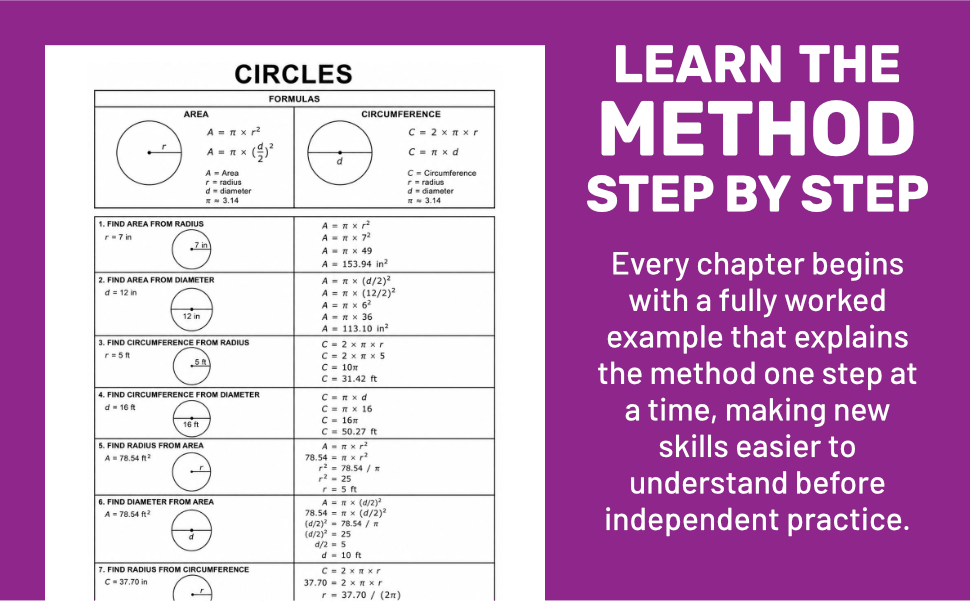
Each chapter opens with a formulas section followed by worked examples.
The examples show the geometric figure, identify the measurements being used, substitute the numbers into the formula, and work through the calculation to the answer.
For example, the Circles chapter demonstrates how to find area from a radius or diameter, circumference from a radius or diameter, and then work backward to find a radius or diameter from a given area or circumference.
The workbook uses the same approach throughout. The opening pages for squares, rectangles, triangles, parallelograms, trapezoids, rhombuses, kites, and regular polygons introduce their formulas and show how those formulas are applied to specific measurements.
Your child sees the method before being asked to reproduce it.
Step 2 – BUILD SKILLS THROUGH PRACTICE
After the worked examples, your child practices the same type of geometry skill.
The practice is organized chapter by chapter, focusing on one geometric topic at a time.
The pages use actual figures with measurements and ask the student to calculate area or perimeter, or work backward to find missing measurements such as a side, length, width, height, radius, or diameter.
Once a method is introduced, your child gets repeated opportunities to apply it with different measurements.

Step 3 – CHECK EVERY ANSWER
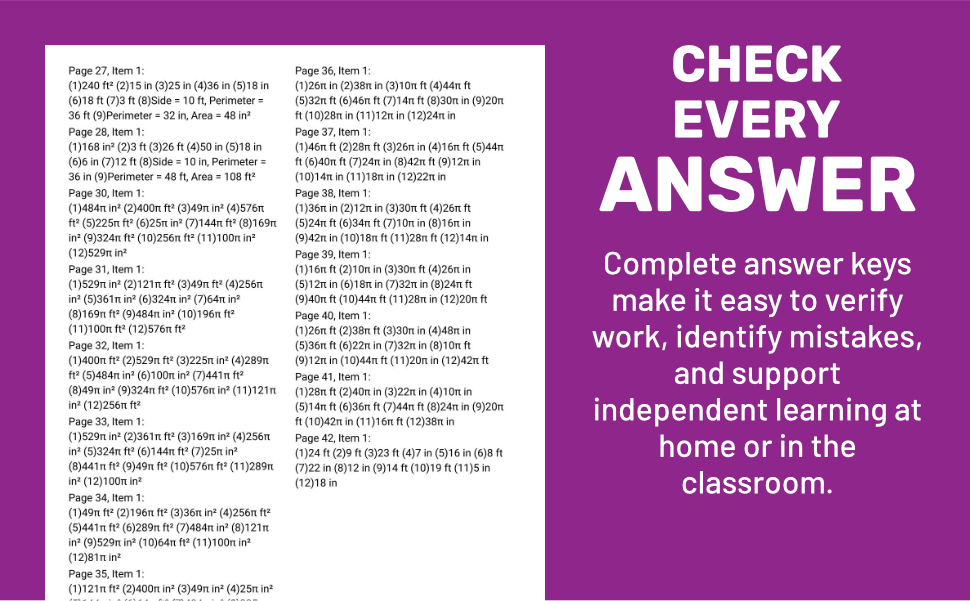
The Answer Key provides answers organized by page and item number.
That makes checking straightforward: your child can complete a page, turn to the corresponding Answer Key entry, and compare the result.
What Your Child Will Practice
SQUARES
Work with mixed area and perimeter problems, including finding a missing side from a given area or perimeter.
RECTANGLES
Calculate area and perimeter and work backward to find a missing length or width.
TRIANGLES
Practice area and perimeter with different triangle types, including problems using given sides, bases, and heights.
CIRCLES
Work with radius, diameter, area, and circumference — including finding a radius or diameter from a given area or circumference.
PARALLELOGRAMS
Calculate mixed area and perimeter problems and solve for missing side or height measurements.
TRAPEZOIDS
Practice mixed area and perimeter problems using trapezoid dimensions, including finding missing measurements.
RHOMBUSES
Work with mixed area and perimeter problems and solve for missing measurements.
KITES
Practice area and perimeter using the measurements provided, including finding missing values.
REGULAR POLYGONS
Find perimeter from a given side length and work backward to find a missing side length.
What This Workbook Is – and Isn’t
It is:
A focused Grade 5 geometry practice workbook organized around nine specific geometric topics, with formulas, worked examples, repeated practice, and an Answer Key.
It isn’t:
A complete Grade 6 mathematics curriculum covering every area of mathematics.
The scope is deliberately focused on geometry – particularly area, perimeter, circumference, and solving for missing measurements across the shapes covered in the nine chapters.
That makes it useful when the goal is more focused geometry practice, rather than general math practice.
Who This Workbook May Be a Good Fit For
This workbook may be a good fit for:
- Students who need additional Grade 5 geometry practice or want to review specific skills such as area, perimeter, circumference, and missing measurements.
- Learners who benefit from seeing a worked example before starting problems on their own.
- Parents and homeschooling families looking for structured geometry practice their child can complete one chapter at a time.
Optional Ways to Use the 5th Grade Geometry Workbook
You don’t have to use the workbook from beginning to end in one continuous sequence.
You can also:
Review Before Practicing
Have your child look through the formulas and worked examples at the beginning of a chapter before attempting the practice page.
Target One Geometry Topic
If your child needs extra practice with circles, rectangles, triangles, or another specific shape, go directly to that chapter.
Practice First, Check Later
Have your child complete a full practice page before opening the Answer Key. This keeps the answer-checking step separate from the actual problem-solving.
Compare the Method
When an answer is incorrect, return to the worked example and compare the student’s calculation with the method shown there.
These are extra ideas you can try at home. They are not activities included in the workbook.

Choose the Format That Works Best for Your Child
Geometry Workbook Grade 5 is available in two formats.
PDF Edition – GUMROAD
$7.99
Choose the PDF if you want:
- Immediate access
- A downloadable workbook
- The flexibility to use it digitally or print it yourself
Paperback Edition – AMAZON
$9.99
Choose the paperback if you prefer:
- A physical workbook
- Writing directly in the book
- A traditional paper-based practice experience